
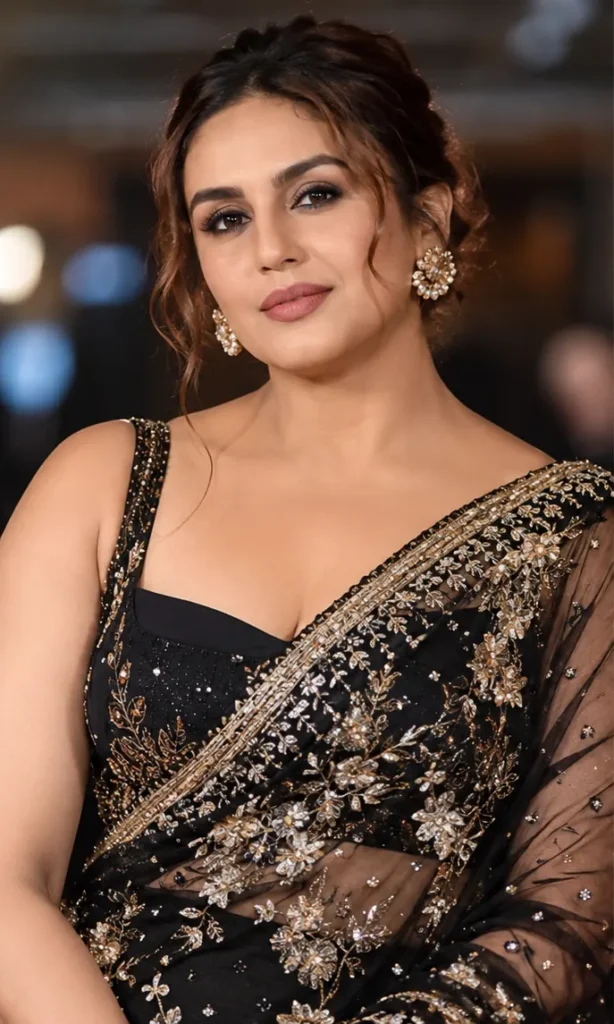
Huma Qureshi choosing roles that challenge her, excite her and leave her creatively satisfied has become one of the clearest patterns in her career. More than a decade after her Hindi-film breakthrough, the actor appears increasingly interested in a simple question: will a project give her something meaningful to do?
That idea sounds obvious, but it becomes more interesting when viewed against the realities of a film industry where actors are often encouraged to chase scale, familiar formulas or the safest possible image. Qureshi’s career has moved in a different direction. From crime dramas and political series to dark comedy, biographical storytelling and mainstream cinema, she has repeatedly stepped into parts that ask audiences to see her differently.
This is not a line-by-line retelling of an earlier interview. Instead, this CinemaSky feature looks at the larger idea behind Qureshi’s comments about happiness, ambition and meaningful work, and connects it with the evolution visible across her filmography.
- A career that did not follow one template
- Why happiness became a career filter
- How Maharani changed the scale of her roles
- Strong women without one fixed definition
- From Tarla to Monica: range over repetition
- Meaningful work and mainstream cinema can coexist
- Creative evolution after a decade on screen
- What her choices reveal about career longevity
A Career That Did Not Follow One Template
Qureshi arrived in Hindi cinema with Gangs of Wasseypur in 2012 after theatre work and advertising. It was not the kind of debut designed around a polished newcomer launch. The film’s rough world, ensemble structure and morally complicated characters immediately placed her in a space where performance mattered more than a carefully manufactured star image.
That beginning proved significant. In the years that followed, she moved through films such as D-Day, Dedh Ishqiya and Badlapur, later expanding into streaming projects and international work. The individual projects differed in scale and reception, but together they established something useful: audiences could not easily reduce her to a single genre.
That flexibility has become more valuable as Indian entertainment has changed. The boundary between theatrical cinema and streaming became less rigid, long-form series created room for characters to evolve over several seasons, and actors could move between formats without treating one as automatically inferior to another.
Qureshi’s career benefited from that change because variety was already part of her identity. Rather than protecting one screen persona, she could use each new format to test another part of her range.
Why Happiness Became a Career Filter
In Femina’s 2024 interview, Qureshi described the frustration of accepting work and later feeling that she could have contributed more. The important idea was not that every role must be a lead role. It was that an actor needs enough material to participate creatively rather than simply complete an assignment.
That distinction explains a lot about her later choices. Creative happiness is not necessarily the same as comfort. A demanding role can be exhausting and still be satisfying. A large commercial production can be exciting, while a smaller project can be equally rewarding if the character has depth. The real dividing line is whether the work gives the performer something to discover.
She has continued expressing a similar philosophy. Discussing Bayaan, Qureshi said she wants to finish a day’s work feeling that she did something meaningful, while also acknowledging the reach and value of popular cinema. That makes her position more nuanced than simply rejecting mainstream films in favour of smaller ones.
For an actor, this kind of filter can also protect against repetition. Once the industry associates a performer with a successful type of character, similar offers naturally follow. Saying yes to all of them may provide short-term visibility, but it can gradually narrow the public’s imagination of what that actor can do.
How Maharani Changed the Scale of Her Roles
Maharani became especially important because it placed Qureshi’s character at the centre of a continuing political drama. Her Rani Bharti begins far from the conventional image of a political power player and has to navigate a world she did not expect to enter.
The long-form structure gives a performer something a two-hour film often cannot: time. A character can learn, fail, change strategy, harden in some places and remain vulnerable in others. Qureshi has spoken about the distinctive feeling of being the primary mover of a story and of the responsibility that comes with occupying that position.
That does not mean every future project has to place her first on the call sheet. It means she has experienced what it feels like when the narrative genuinely depends on her character’s decisions. Once an actor has that experience, a decorative role with little room to contribute may naturally become less appealing.
The series also helped demonstrate that a female-led project does not have to fit a narrow idea of what “women-centric” entertainment looks like. Political strategy, family pressure, ambition, survival and public power can all exist inside the same character arc.

Strong Women Without One Fixed Definition
The phrase “strong female character” is often used so broadly that it can lose meaning. Strength does not require a woman to be fearless in every scene, physically dominant or emotionally invulnerable. In fact, characters become more convincing when confidence exists alongside insecurity, contradiction and mistakes.
Qureshi has made a similar point across interviews. She has said she is interested in women who feel three-dimensional rather than functioning as accessories to somebody else’s journey. Earlier, while discussing Maharani, she also emphasized that strength should not require sacrificing vulnerability and softer qualities.
This helps explain why her filmography can contain characters who look very different from one another while still feeling connected by agency. The connection is not that they are all “powerful” in the same way. It is that they have desires, flaws and consequences of their own.
That difference matters for audiences too. If female-led storytelling merely replaces one rigid stereotype with another, the range of possible characters remains limited. A more interesting goal is to let women on screen be funny, ambitious, selfish, frightened, loving, morally uncertain, competent or chaotic — sometimes several of those things at once.
From Tarla to Monica: Range Over Repetition
Tarla offered Qureshi a very different challenge from a political drama. Playing culinary personality Tarla Dalal required a transformation built around manner, rhythm and personality rather than conventional glamour. The attraction of such a role is easy to understand within Qureshi’s larger philosophy: it asks the performer to move away from her familiar screen self.
Then there is Monica, O My Darling, a darkly comic crime story where her character Monica Machado is not simply present around the plot — she actively disrupts it. The film’s heightened tone required a different performance language from Maharani or Tarla.
Leila represented another important step. Qureshi recalled that working with filmmaker Deepa Mehta pushed her outside her previous comfort zone, including appearing without the kind of makeup presentation she had been accustomed to. She described that experience as part of her personal evolution.
Seen together, these projects make the pattern clearer. The objective is not simply to collect “serious” roles. It is to avoid creative sameness. Comedy, political drama, thriller, biographical storytelling and mainstream entertainment can all serve that goal when the character offers a new problem to solve.
Meaningful Work and Mainstream Cinema Can Coexist
There is an easy but misleading way to divide an actor’s choices into two boxes: meaningful work on one side and commercial work on the other. Qureshi’s comments suggest she does not see the choice so narrowly. She has acknowledged that popular cinema provides reach, while also saying that she wants layered characters that can stay with viewers beyond immediate box-office performance.
That balance is increasingly normal in Indian entertainment. An actor can headline a streaming drama, appear in a broad theatrical film, take a supporting part with unusual texture and then move into an independent or international project. The formats can strengthen one another because each introduces the performer to a different audience.
The more useful question is therefore not “Is this commercial?” but “What does this role allow the actor to do?” A mainstream film with a sharply written character can offer enormous creative satisfaction. A supposedly prestigious project with a thinly written part may offer very little.
That perspective also makes box-office results only one part of a career. Commercial performance matters to an industry built around investment, but actors build long-term identities through memorable characters as well as hits.
Creative Evolution After More Than a Decade on Screen
Experience changes what an actor can reasonably demand from a role. Early in a career, visibility itself can be valuable. Later, the calculation changes. A performer who has already demonstrated range may become more selective about how a new project expands that body of work.
Qureshi’s recent interviews show that creative freedom has become increasingly important to her. In 2026, she described resisting attempts to put her into a box and emphasized the value of being able to shape her career on her own terms.
That evolution is not the same as having complete control. Film and television remain collaborative industries. Scripts change, projects are delayed, audience reactions are unpredictable, and every performer works within financial and logistical realities. But greater experience can provide a clearer sense of what is worth pursuing.
It can also create confidence to say no. Turning down a familiar role may feel risky because there is no guarantee that a more interesting one will immediately arrive. Yet avoiding repetition can be part of protecting a career’s long-term value.
Why OTT Was More Than a Change of Platform
Streaming played a major role in this phase of Qureshi’s career. She has previously discussed taking chances with OTT work at a time when some industry perceptions treated it as a less desirable path. Her experience illustrates how quickly those assumptions changed as long-form digital storytelling became a major part of Indian entertainment.
For performers, streaming also changed the amount of narrative space available. A multi-episode season can explore a character’s contradictions in ways that are difficult when a theatrical film has to distribute two or three hours among many characters and commercial requirements.
Qureshi later leaned into that identity, speaking proudly about the impact of her OTT work and her interest in playing real women rather than repeating one kind of fierce character.
The important point is not that streaming is automatically better. It is that another strong storytelling ecosystem gives actors more routes to interesting work. More routes mean less pressure to wait for one narrow definition of a “perfect” Bollywood role.
What Huma Qureshi’s Choices Reveal About Career Longevity
Qureshi’s journey offers a useful lesson about longevity: reinvention does not always require a dramatic comeback. Sometimes it happens gradually through a sequence of decisions that expand what audiences expect from you.
One project establishes dramatic credibility. Another proves comic timing. A series demonstrates that the performer can carry a long narrative. A biographical role demands transformation. A mainstream film brings scale. Over time, those choices create a career that is harder to define with a single label.
There is also a practical lesson in her emphasis on happiness. Creative careers are uncertain, and external validation is unstable. Reviews change, algorithms change, box-office expectations change and public attention moves quickly. If the only measure of success is the reaction outside the set, satisfaction becomes difficult to control.
Choosing work that feels worthwhile does not eliminate those pressures. It simply gives the artist another measure: Did I learn something? Did I contribute? Did the role challenge me? Did I come home feeling that the day had meaning?
That may be the most valuable context behind Qureshi’s approach. Happiness, in this sense, is not about choosing the easiest job. It is about choosing the work that makes the difficulty feel worthwhile.
Where Her Career Philosophy Appears to Be Heading
Her later work has continued to test that philosophy. Qureshi has discussed wanting complex women with agency, while moving between projects with very different tones. Interviews around Bayaan again showed her interest in layered characters and in refusing the idea that female performers must choose permanently between mainstream visibility and nuanced work.
By 2026, the language had become even clearer: creative freedom itself was being treated as a form of success. That is a meaningful shift from the earlier-career need to establish oneself. The question is no longer simply whether she can get interesting parts; it is how many different directions she can take them.
For viewers, that makes the next role difficult to predict — and that unpredictability may be an advantage. When an actor becomes too easy to imagine in a part, surprise disappears. Qureshi’s strongest choices have often worked because they complicate what the audience thought her screen identity was supposed to be.
Final Thoughts
Huma Qureshi’s career is not a perfectly straight line, and that is precisely what makes it interesting. It contains commercial films, streaming series, ensemble work, lead roles, experiments and projects that received very different levels of attention. What increasingly connects them is a desire for characters that allow her to participate in the storytelling rather than simply occupy space within it.
Her idea of choosing roles that make her happy should therefore not be confused with choosing only comfortable roles. The evidence across her work points in the opposite direction. The roles that seem to energise her are often the ones that require transformation, contradiction, responsibility or risk.
More than a decade after Gangs of Wasseypur, that approach has given Qureshi something valuable: a filmography in which a political leader, a homemaker, a culinary icon, a noir figure and other complicated women can all sit beside one another without feeling like the same performance repeated under different titles.
For an actor who has repeatedly spoken about wanting to expand her horizon as a performer, that may be a more durable achievement than fitting neatly into any single box.
Frequently Asked Questions
What does Huma Qureshi look for when choosing roles?
Her interviews suggest that creative satisfaction, meaningful material and enough space to contribute as a performer are important factors. She has also expressed interest in layered characters and collaborations that challenge her.
Why is Maharani important in Huma Qureshi’s career?
Maharani gave her a continuing central character whose decisions drive a large political narrative. Qureshi has described the experience of being a story’s prime mover as empowering.
Does Huma Qureshi only want female-led projects?
No. Her comments indicate that she values substantial, interesting characters and also recognises the reach of mainstream cinema. The quality and possibilities of the role appear more important than fitting every project into one category.
Which projects show Huma Qureshi’s range?
Gangs of Wasseypur, Badlapur, Leila, Maharani, Monica, O My Darling and Tarla illustrate notably different sides of her screen work.